
How to Start a Profitable Maize Flour Mill in Uganda: Complete Step-by-Step Guide

Uganda is one of the fastest-growing maize processing markets in East Africa. With maize (locally known as posho) being a daily staple food, demand for maize flour remains strong across households, schools, restaurants, and institutional buyers.
For investors, starting a maize flour milling business in Uganda is highly profitable when the project is properly designed from raw material sourcing to production system selection.
This guide explains the complete process step by step.
1. Understand the Maize Flour Market in Uganda
Maize flour is a daily essential food in Uganda, consumed widely in both rural and urban areas.
Key demand drivers include:
Household consumption of posho
School feeding programs
Restaurants and catering services
Retail shops and supermarkets
Because of this stable demand, maize milling remains one of the most reliable agro-processing businesses in Uganda.
2. Secure a Stable Maize Supply Chain
Raw material supply determines whether the factory can operate consistently.
Uganda has strong maize production in the Eastern and Central regions. A successful project usually requires:
Direct sourcing from farmers or aggregators
Seasonal bulk purchasing during harvest periods
Proper drying systems to avoid aflatoxin contamination
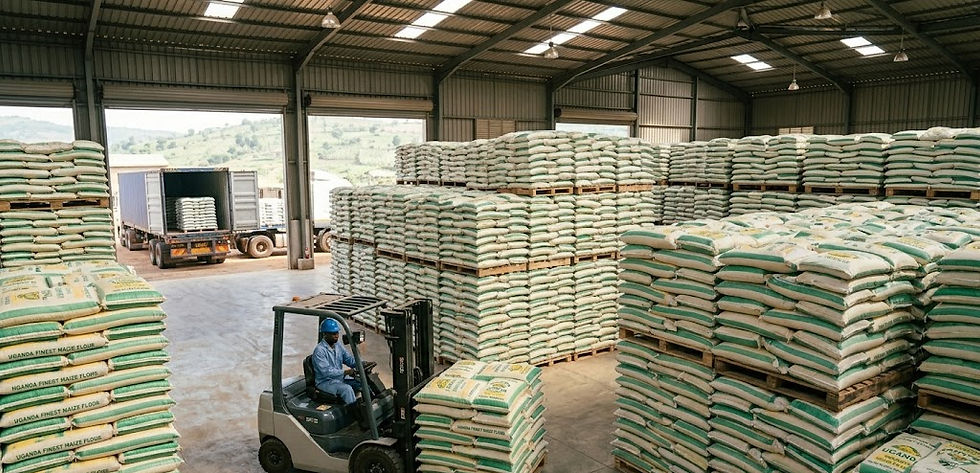
Warehouse storage for year-round production stability
Without a stable supply, even a well-designed factory cannot perform efficiently.

3. Choose a Suitable Factory Location
Factory location directly affects logistics cost and production efficiency.
An ideal maize milling site should have:
Close access to maize-producing areas
Stable three-phase electricity supply
Truck-friendly transportation routes
Adequate warehouse and expansion space
Clean and safe environment for food production
In many successful projects across Africa, location planning is treated as important as equipment selection.
4. Maize Milling Equipment Selection and Evaluation
A complete maize flour milling plant generally includes:
Cleaning system, conditioning system, degerminating section, milling section, sifting system, and packaging unit.
Standard process flow:
Cleaning → Conditioning → Degerminating → Milling → Sifting → Packaging
Each stage directly affects flour quality, especially when producing fine posho flour, which is the dominant product in the Ugandan market.
In practical engineering projects, investors usually focus on systems that can handle:
Mixed-quality raw maize
High impurity levels common in local grain supply
Continuous 24-hour operation demand during peak seasons
Stable output quality for branded flour production
This is also where equipment design becomes critical. In many African maize milling projects, integrated industrial systems designed for local grain conditions are widely adopted because they reduce downtime, simplify operation, and maintain consistent flour quality under variable raw material conditions.

5. Installation and Commissioning
After equipment arrives at the site, proper installation ensures long-term stability:
Layout installation based on production flow
Electrical system configuration and safety checks
Operator training for daily production
Trial production before full-scale operation
Correct commissioning reduces long-term maintenance costs and improves production efficiency.
6. Legal Registration and Compliance in Uganda
To operate legally, investors must complete:
Business registration
Food production licensing
Uganda National Bureau of Standards (UNBS) certification
Local health and safety inspections
These requirements are essential for entering supermarket and institutional supply chains.
7. Sales Channels and Market Strategy
Production alone does not guarantee profitability. A strong distribution system is required.
Common sales channels include:
Local wholesalers and retail distributors
Supermarkets with packaged branded flour
Schools and institutional contracts
Regional distributors across districts
Branding and packaging significantly improve product value and market competitiveness.
8. Investment Scale Options
Maize flour milling projects in Uganda can be developed in different capacities:
Small-scale (5–30TPD): local community supply
Medium-scale (30–50TPD): commercial distribution
Large-scale (100TPD+): industrial production and branding
Among all cost components, working capital for maize procurement is usually the largest requirement.
Conclusion
Starting a maize flour mill in Uganda is a highly promising investment due to strong demand and abundant raw material supply. However, long-term success depends on:
Stable maize sourcing system
Proper factory planning and location selection
Reliable and well-designed milling system
Strong distribution and branding strategy
When these elements are properly integrated, a maize milling business can achieve stable and long-term profitability in Uganda’s growing food processing industry.
Contact Us
For complete maize flour milling plant solutions, project design, and technical consultation:
Contact: Jane
Phone / WhatsApp: +86 139 3305 7265



Comments